Monday, July 18, 2011

Video : Đàn áp dã man lòng yêu nước – CA đạp vào mặt người biểu tình


***

Danlambao vừa nhận được một video ngắn do bạn đọc gửi đến, ghi lại cuộc đàn áp, đánh đập dã man của lực lượng CA đối với người biểu tình yêu nước vào sáng chủ nhật, 17/07 vừa qua.

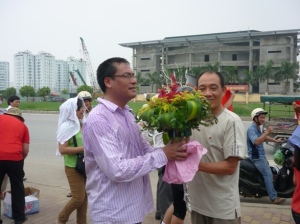
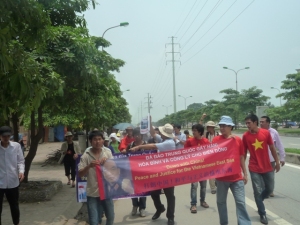
Cập nhật: ảnh của anh Nguyễn Trí Đức do blogger Nguyễn Tường Thụy cung cấp.


Đoạn clip tuy ngắn, nhưng là một băng chứng rõ rệt nhất về sự hung bạo của lực lượng An ninh đối với những người biểu tình yêu nước. Thời gian xảy ra sự việc vào sáng 17/07, lúc này đoàn biểu tình tại Hà Nội đang bị đàn án dữ dội.

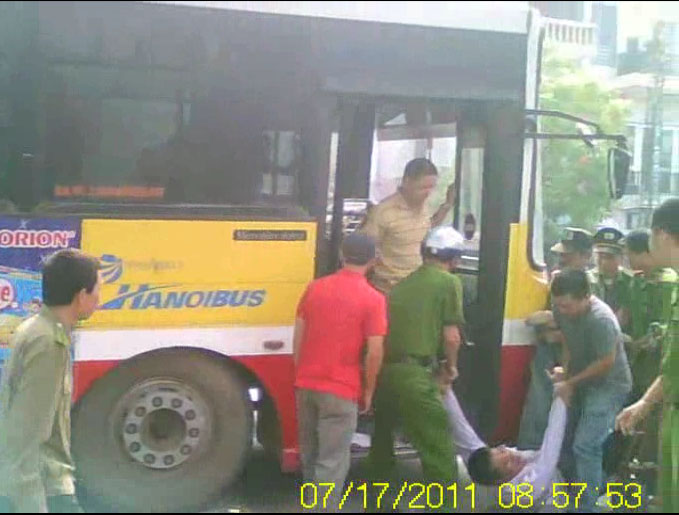
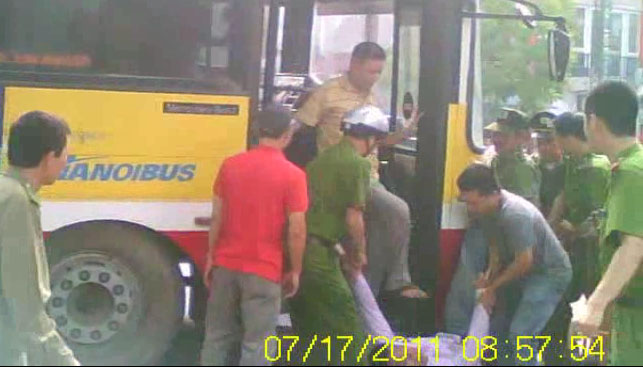
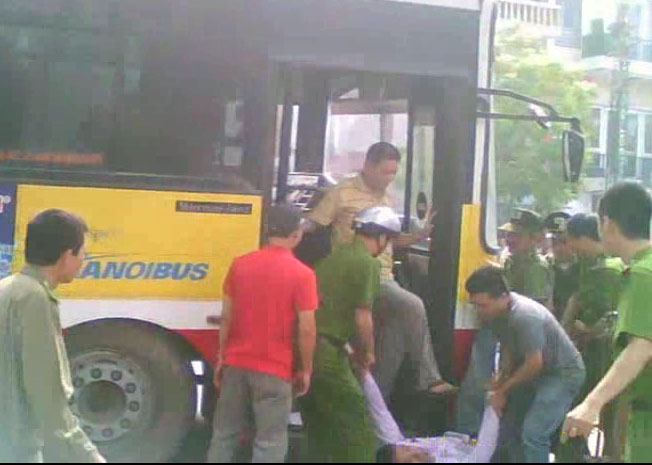
Bắt đầu là hình ảnh một người tên Nguyễn Trí Đức trong đoàn biểu tình bị CA bắt lôi lên xe bus , ít nhất 5 viên công an thường phục lẫn sắc phục, kẻ nắm tay, người nắm chân khiêng đi. Anh Nguyễn Trí Đức  chỉ có thể phản ứng bằng những tiếng kêu cứu thảm thiết.

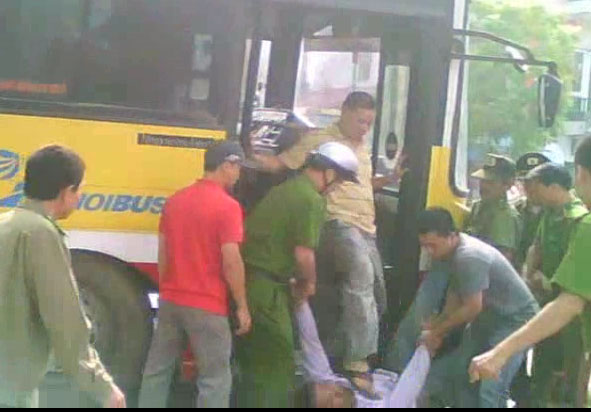
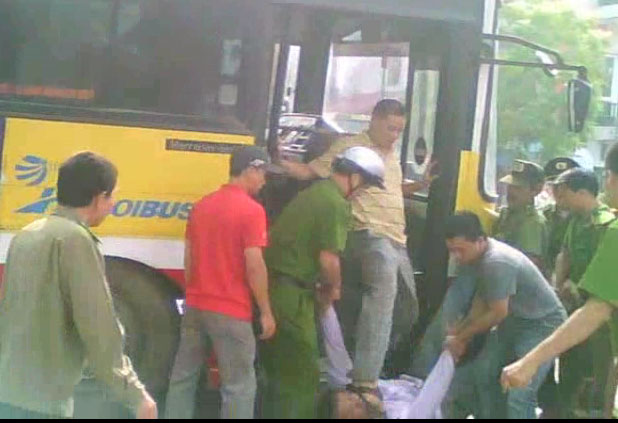
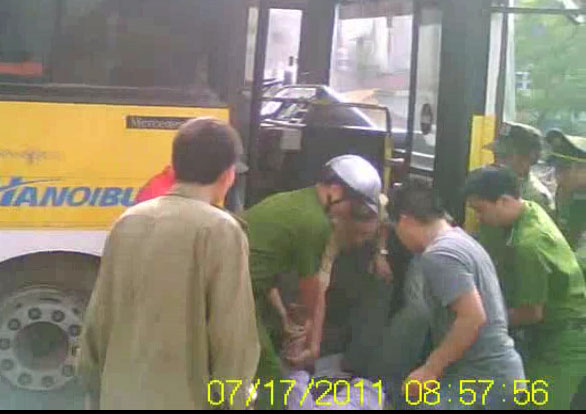
Lúc 08:57 , người bị bắt bị CA lôi đến trước cửa chiếc xe bus chờ sẵn, một viên an ninh chìm đầu đinh (mặc áo vàng nhạt) từ trên xe lạnh lùng bước xuống vài bậc, rồi bất ngờ nhấc chân đạp thẳng vào mặt, miệng của anh Nguyễn Trí Đức, lúc này không thể phản kháng

Bị dính một cú trời giáng, anh Đức la lên vài tiếng, lấy tay ôm mặt. Viên công an chìm đầu đinh tiếp tục cúi xuống để lôi nạn nhân lên xe bus. Trước khi biến mất, người đàn ông kịp kêu lên tiếng cầu cứu cuối cùng : “Bà con ơi, cứu tôi !”

Sự việc chỉ diễn ra đúng 2 giây, trong một không gian đầy những viên công an thô bạo, nhưng tất cả đã được bạn đọc VNHH kịp thời ghi lại, trở thành một bằng chứng không thể chỗi cãi về hành vi CA dùng bạo lực để trấn áp những người yêu nước ôn hòa.

Trong cuộc đàn áp biểu tình vào sáng chủ nhật 17/07, theo ghi nhận có tổng cộng 46 người bị bắt ở Hà Nội và 11 người bị bắt ở Sài Gòn. Những người bị bắt đều đã được thả ra, một số khác thì bị tra khảo đến tận tối, có trường hợp bị cướp tài khoản cá nhân trên mạng.

danlambao xin chân thành cảm ơn bạn đọc VNHH đã gửi đến đoạn videp trên

http://danlambaovn.blogspot.com/


Cập nhật : Bạn Nguyễn Tường Thụy gửi phản hồi cho biết :

Người đàn ông này là Nguyễn Trí Đức mà tôi có nhắc tới trong bài “Nhật ký biểu tình”:
“Lên xe rồi tôi tiếp tục quan sát việc bắt bớ. Bỗng huỵch một cái, chúng ném một người lên, nằm xoài trên sàn xe như là vứt một con vật lên bàn mổ. Đó là một thanh niên. Tôi hỏi chuyện, em cho biết em là Nguyễn Trí Đức, sinh năm 1976. Em kể bị chúng nó đạp 1 cái vào bụng và 2 cái vào mồm”.

Xin cũng cấp thêm cho DLB mấy cái hình có Nguyễn Trí Đức.

Hình Đức cầm bó hoa, đeo kính, áo kẻ dọc phớt hồng là rõ nhất (lúc cuộc biểu tình chấm dứt gần Bảo tàng HN).

Còn hai hình kia, căn cứ vào đặc điểm của Đức trong hình chụp gần thì mọi người dễ nhận ra anh (một cái chụp chung với những người bị bắt, một cái đi bên phải trong đoàn biểu tình từ đồn công an Mỹ Đình đến Bảo tàng HN) – blogger Nguyễn Tường Thuỵ –
***


***


***


Hình ảnh chụp lại từ Clip :

***


Người đàn ông trong đoàn bị bắt bị khiêng đến trước cửa chiếc xe bus đợi sẫn, viên An ninh chìm  đầu đinh (áo vàng nhạt) từ trên xe bước xuống vài bước


***


Chuẩn bị tư thế


***


 Nhấc chân


***


Đạp thẳng vào mặt người biểu tình bị bắt


***


Cú đạp trúng thẳng vào mặt và miệng người đàn ông bị bắt


***


***


Người đàn ông đau đớn lấy tay ôm mặt, kêu lên vài tiếng


***


Viên An Ninh chìm tiếp tục cúi xuống lôi người đàn ông lên xe bus, mặc cho nạn nhân đau đớn kêu cứu


***
>> Cập nhật :

Khuôn mặt của viên An ninh chìm đã dùng chân đạp vào mặt anh Nguyễn Trí Đức.

Một bạn đọc ở Thái Hà đã cung cấp thông tin như sau : Viên công an này tên Minh, trước đây thường xuyên xuất hiện tại Nhà thờ Thái Hà để theo dõi giáo dân
.
Ảnh lớn là hình Công an tên Minh đang bắt anh Nguyễn Tiến Nam trong vụ biểu tình phản đối rước đuốc Bắc Kinh hồi năm 2008. Ảnh nhỏ kế bên là khuôn mặt của Minh xuất hiện tại nhà thờ Thái Hà để cướp máy ảnh của giáo dân. Sau đó, nhiều giáo dân đã vạch mặt An ninh tên Minh , khiến anh ta không còn dám xuất hiện tại Thái Hà nữa.
_oOo_

Friday, July 15, 2011

U.S., Vietnam Begin Naval Exercises Amid Tension With China

The United States and Vietnam launched a series of joint naval exchanges on Friday in the latest sign of warming ties between the former foes, as both nations grapple with ways to contain a more-assertive China.


Associated Press

A Vietnamese naval officer stands guard near a U.S. Navy salvage ship in Danang, on Friday. The noncombat training exercises between the allies have raised concerns about further straining relations with China.


The exchanges, which are confined to noncombat training, fall short of the kinds of advanced military exercises that occur between the U.S. and longer-term allies in the region, such as the Philippines and Australia. But they underscore a push by the U.S. to deepen military ties across Southeast Asia, especially in the face of greater shared concerns over China, which has spent aggressively in recent years to enhance its military capabilities.

The U.S. strategy includes an expansion of training exercises in other parts of the region to include newer participants, such as Cambodia and Malaysia, in some programs, as well as the deployment of new hardware, including littoral combat ships in Singapore.

Although U.S. officials stressed the week of Vietnam exchanges has been planned for months, the maneuvers risk further straining relations with China at a time when tensions already are high because of disputes over the South China Sea, a potentially oil-rich area where Vietnam, the Philippines, Taiwan, Brunei, Malaysia and China all have conflicting territorial claims. Vietnam accused China of interfering with a Vietnamese oil-exploration boat in June, and the Philippines has likewise complained about Chinese intimidation of survey vessels recently. Last week, the Philippines told China it plans to raise disputes over the South China Sea with a United Nations tribunal—a proposal China promptly rejected.

Gen. Chen Bingde, chief of the General Staff of the Chinese People's Liberation Army, said Monday the timing of U.S. naval exercises with Vietnam and also recently with the Philippines was "inappropriate" in light of the South China Sea issues.

On Friday, Adm. Mike Mullen, chairman of the U.S. Joint Chiefs of Staff, said at a news conference in Tokyo that recent meetings with Chinese military leaders including Gen. Chen were "productive and generally positive," though he noted "there is a long way to go."

The push to expand cooperation between the U.S. and some Southeast Asian nations presents its own challenges, especially between the U.S. and Vietnam, which normalized relations in 1995, 20 years after the Vietnam War. Both countries are wary of going too far and possibly antagonizing China.

>> Meanwhile, some top Vietnamese leaders remain suspicious of U.S. motives. They worry the U.S. intends to more aggressively promote democratic changes in Vietnam or to support human-rights activists whose work could undermine the government there, according to people familiar with discussions between the two countries.

Still, relations have for the most part blossomed in recent years, with rapidly expanding trade and investment ties. Military cooperation has gradually expanded since the first U.S. warship visited the country since the Vietnam War in 2003 and last year included some training exercises.

U.S. officials also are looking to boost training programs elsewhere in Southeast Asia as part of a wider strategy to enhance its ability to police international waterways, and to lift the confidence and military capabilities of smaller Southeast Asian countries, some of which have privately questioned the U.S.'s commitment to the region as it devotes resources to the Middle East.

At the annual Shangri-La Dialogue Asian security meeting in Singapore last month, U.S. Defense Secretary Robert Gates said the U.S. military would be "increasing its port calls, naval engagements, and multilateral training efforts" in the region to "help build partner capacity to address regional challenges." Those efforts, he said, included stepped-up cooperation with Singapore with the deployment there of littoral combat ships, which are relatively new and fast combat vessels designed to operate close to shorelines.

Other efforts include the expansion this year of annual Cobra Gold exercises between the U.S., Thailand and other Asian countries to include Malaysian troops for the first time. The Cooperation Afloat Readiness and Training, or Carat, program that involves bilateral military exercises between the U.S. Navy and more than a half-dozen Asian countries, recently expanded to include Cambodia and is adding Bangladesh. In June, Carat exercises with Malaysia included a U.S. attack submarine for the first time in the exercise's 17-year history.

"The exercises are becoming more complex and of longer duration," and tend to involve a larger number of countries than in the past, said Ian Storey, a fellow at the Institute of Southeast Asian Studies in Singapore.
"I think this is going to make the Chinese quite nervous" as the U.S. tries to expand its presence there, added Bonnie Glaser, a senior fellow at the Center for Strategic and International Studies in Washington.

This year's Vietnam activities, held in the port city of Danang, include two guided missile destroyers, the USS Chung-Hoon and USS Preble, as well as a rescue and salvage ship, while last year's activities involved the USS John S. McCain warship. The activities also will feature an increased number of noncombat activities, such as search-and-rescue missions and navigation training, as well as some cultural and trust-building exercises, including community-service projects.

"We've had a presence in the Western Pacific and the South China Sea for 50 to 60 years, even going back before World War II,"' Rear Adm. Tom Carney, who is leading the naval exchange, told reporters in Danang, according to the Associated Press. "We have no intention of departing from that kind of activity."

—Yoree Koh contributed to this article.

http://online.wsj.com/article/SB10001424052702304223804576447412748465574.html


_oOo_
7/15/2011


US navy ships visit Vietnam amid heightened China tensions

Beijing criticizes port call as Washington strengthens ties with its neighbors

DANANG, Vietnam — Three U.S. Navy ships were welcomed Friday by former foe Vietnam for joint training, despite China's irritation following weeks of fiery exchanges between the communist neighbors over disputed areas of the South China Sea.

U.S. and Vietnamese officials have stressed that the seven-day ship visit and naval training are part of routine exchanges planned long before tensions began flaring between China and Vietnam in late May. China has criticized the port call as inappropriate, saying it should have been rescheduled due to the ongoing squabble.
The U.S. visit, however, did send a message that the Navy remains a formidable maritime force in the region and is determined to build stronger military ties with smaller Southeast Asian countries.

"We've had a presence in the Western Pacific and the South China Sea for 50 to 60 years, even going back before World War II," Rear Adm. Tom Carney, who's leading the naval exchange, told reporters.

"We will maintain a presence in the Western Pacific and the South China Sea as we have for decades, and we have no intention of departing from that kind of activity."

He spoke on the pier in central Danang, once home to a bustling U.S. military base during the Vietnam War, in front of the diving and salvage ship USNS Safeguard. American and Vietnamese flags flapped in the steamy air from the ship, and two guided missile destroyers — USS Chung-Hoon and USS Preble — were visible off the coast.

The two navies will hold exchanges involving navigation and damage control along with dive and salvage training. No live-fire drills will be conducted.

Spat with China

Vietnam and China last month both announced their navies held such maneuvers individually in the South China Sea after relations hit a low point when Hanoi twice accused Beijing of hindering oil exploration within Vietnam's economic exclusive zone.

China responded that Vietnamese boats had endangered Chinese fishermen in a different area near the contested resource-rich Spratly islands, claimed all or in part by both nations and several others.

Tempers appeared to be cooling after Chinese and Vietnamese officials met last month and announced they would work to negotiate a peaceful resolution. But Vietnamese state-run media and a border official on Wednesday accused armed Chinese soldiers of attacking and chasing a Vietnamese fishing boat near the disputed Paracel islands claimed by both countries.

The Philippines has also recently sparred with China, alleging similar interference with its energy exploration efforts in the South China Sea. The United States last month conducted similar joint naval exercises that included live-fire drills with the Philippines, a treaty ally.

On Monday in Beijing, top Chinese Gen. Chen Bingde criticized his U.S. counterpart for going forward with the exercises in Vietnam and the Philippines, calling it bad timing in light of the ongoing spats. Adm. Mike Mullen, chairman of the U.S. Joint Chiefs of Staff, defended the decision saying the exchanges were pre-planned.

.."I don't know when an appropriate time would be for these kind of activities, which are designed to promote friendship and cooperation," Carney said from the Vietnam pier. "But I don't think there's ever a bad time to do those kind of activities."

Washington has said that the South China Sea, home to major shipping lanes, is in its national interest. China, which has an expanding maritime influence, has designated the area as a core interest — essentially something it could go to war over. Worried smaller neighboring countries have looked to the United States to maintain a strong presence in the region.

"The U.S. has made its point and will continue to do so if pressed, but does not appear to be looking for a fight with Beijing on this issue," said Ralph Cossa, president of Pacific Forum CSIS, a Hawaii-based think tank. "It is not likely to heed or back down as a result of Chinese 'warnings,' however, which will likely make Washington feel more compelled to respond."

Improved ties

The current U.S. visit to Vietnam involves about 700 sailors and builds on the first postwar port call in 2003 made to the former Saigon, now called Ho Chi Minh City. Since then, military relations have continued to grow with high-level defense visits and exchanges.

The two sides recently began working together to clean up dioxin contamination from the defoliant Agent Orange. It was mixed and stored at the U.S. air base in Danang and remains one of the lasting legacies of the Vietnam War that killed some 58,000 Americans and an estimated 3 million Vietnamese.

The war ended in 1975 when U.S.-backed South Vietnam fell to northern communist forces and the country was reunified. The U.S. and Vietnam shook hands in 1995 and established diplomatic relations, signing a landmark trade deal six years later.

Today, the U.S. is Vietnam's top export market, while Americans are among the country's leading foreign investors.


Colonel Nguyen Van Lam greets Rear Admiral Carney during a welcoming ceremony in Vietnam's central Danang city


Vietnam's Colonel Nguyen Van Lam greets U.S. Rear Adm. Tom Carney, right, in a welcoming ceremony at Tien Sa port, in Vietnam, on Friday.

Wednesday, July 13, 2011

MỘT THỜI ĐỂ NHỚ MỘT THỜI ĐỂ QUÊN

* 

Biểu tình chống bá quyền Tàu cộng ở Sài Gòn 6/05/2011

You’re my Hero, little sister!
*
***
***

 Ouch!
*
 ***


Phải giết sạch CS thì người dân mới có cơm no áo ấm!


_oOo_

***


***


MỘT THỜI ĐỂ NHỚ MỘT THỜI ĐỂ QUÊN

Mẹ tôi năm nay 81 tuổi, đã lẫn gần chục năm. Những năm gần đây càng nặng. Mặc dù vẫn đi lại bình thường nhưng đã mất cảm giác đói, no. Tôi vẫn phải làm mặt hình sự mỗi khi đút cho bà ăn hoặc cho uống thuốc. Bà vẫn nhớ tên các con nhưng không biết thằng đang đút cho mình ăn, là cái thằng nào? Cổng trong, cổng ngoài lúc nào cũng khóa hai lớp, chẳng phải vì vấn đề an ninh mà vì sợ bà bỏ đi bụi đời! Nhiều hôm, tôi và vợ phải túa đi tìm vì bà lẻn ra ngoài hồi nào không biết? May có cậu bảo vệ quán cafe khu phố bên cạnh giử lại vì thấy bà già đi lang thang mà miệng lại lảm nhảm. Từ đấy cổng lúc nào cũng khóa hai lớp.

Monday, July 11, 2011

Submarine Hunting: Anti-Submarine-Warfare (ASW)


Project 877/Kilo-class submarine. (Photo by Guy Toremans, via author)


In general, there are three types of ASW-platforms:

-Airborne, including helicopters and planes

-Surface units, including frigates, destroyers as well as small coastal submarine hunters

-Submerged units, including diesel-electric submarines and Nuclear submarines.

The most important thing about hunting a submarine is detecting it.

It consumes a lot of time and effort. Once the submarine is detected, it is – relatively – easy to hit and sink. The searching and detecting of a submarine is still a risk bearing operation, depending on the asset and weapon you use.

Since anyone wants to take the least risky method of finding and killing a submarine, airborne ASW platforms remain the most popular.

In response, some of modern submarines are now equipped with MANPADS (Man-Portable Air Defense Systems), but these have not proved as effective as the submarine has to surface in order to use them, in turn exposing itself to enemy fire. Some research for a torpedo-tube launched anti-helicopter weapon, named “Triton”, was undertaken by Germans, but no such weapon entered service so far.


Target

Every submarine is a highly evasive, problematic to detect, “hard” target. Usually, a submarine will be actually invisible even to the eyes of any observer on the surface, and definitely not visible on any radar – as long as it remains submerged.

 The currently available detection technology is therefore based on magnetic deviations and sound waves. Clearly, in response to such threats submarine-constructors adapted their products, making them ever silent.

By nature, a submerged submarine is therefore “invisible”, and therefore an extremely potent weapon. It can manoeuvre, move swiftly, or stand still, dive through so-called thermic layers in order to hide, shoot noise makers, use the bottom of the sea to hide, but also to find a target for itself. This all does not make any submarine a “miracle” by itself, however, then there are still the ways of detecting submarines – even if these are usually complex and full of problems.

Airborne Platforms

As already mentioned, airborne anti-submarine warfare (ASW) platforms are foremost helicopters and aircraft. As seen from the submarine, they are actually invulnerable and far more manoeuvrable – due to their advantage in speed. This speed permits them to change their position much faster than any submarine and thus not only cover large areas when searching for their targets, but also have a choice of time and point from which they attack, relative to the submarine position.

Helicopters are slower than aircraft and usually have a much shorter endurance, but they have the ability to move in a far more methodical way, and even hover over an area. They are also smaller in size and weight and can be carried by small ships.

ASW-Helicopters are usually equipped with MADs (“Magnetic Anomaly Detectors”), dipping sonar (active and passive) and sonobuoys (also active and passive); ASW aircraft are all equipped with MAD and sonobuoys only, while some also have powerful surface-search radars. MAD-detectors can detect submarines only within a quite limited zone. Dipping sonar and sonobuoys are the most effective means of submarine hunting, then they enable the crew of the helicopter to listen to underwater sounds over extended periods of time.

On this photograph of a USN Lockheed P-3C Orion with a Soviet Navy Project 671RTM/Victor III-class SSN, the MAD-detector of the Orion, mounted in the lenghty extension on the rear fuselage, behind the fin, can be seen to advantage. (Photo: Tom Cooper collection)

Modern ASW-Helicopters are mainly equipped with advanced guided torpedoes, but also with depth charges, and light anti-ship missiles.

ASW-Aircraft are much faster than either submarines or helicopters, and usually have an extended range and excellent endurance. However, their speed precludes them from using a dipping sonar, and when it comes to detection means related to sound they are limited to carriage of sonobuoys, and a MAD-detector. The largest disadvantage of ASW-Aircraft is that they most of them – except for such aircraft like Lockheed S-3 Viking (which, however, is not any more used for ASW-purposes) – are limited to the use from land-bases.
Contrary to the ASW-helicopters, however, ASW-aircraft can carry much larger loads of weapons (including guided torpedoes, mines, and depth charges), as well as many more sonobuoys.

Surface Platforms

Surface platforms – usually called “warships” – clearly have the much longer range and endurance than any airborne assets. They are, however, also much heavier and larger, carrying far more equipment and weapons – but also much slower.

There are several different types of surface ASW-platforms: they can either serve as bases for ASW-helicopters (or, in case of some ASW-carriers, for ASW-aircraft), or – in the case of corvettes, frigates and destroyers – can operate in combination with airborne ASW-assets. There are also small and fast coastal-patrol vessels, which usually do not carry any airborne platforms, but can cooperate with these to search for submarines.

The concept of the large, purpose-built ASW-platform, such like ASW-carrier, appears to have been dropped since the end of the Cold War: while in the 1960s and 1970s the USN operated special “ASW carriers” (like re-conditioned ships of Essex-class, carrying S-1 and E-1 Trackers), the Soviet Navy operated helicopter carriers of the Kiev- and Moskva-class, Italians have built their Giuseppe Garibaldi carrier or the cruiser Vitorio Venetto, while later the Japanese followed with their “helicopter-carrying destroyers” of Haruna- and Shirane-class, today nobody is building such ships any more, and the general preference are “multi-purpose ships”.

Smaller surface ASW-combatants usually weight up to 1.000 tons and can reach speeds of up to 40kts. Because of their speed, however, they need powerful machinery, and the space for equipment and weapons on such hulls is therefore usually rather restricted. Nevertheless, even such platforms are usually equipped with hull-mounted and dipping sonar, and some even have – usually very expensive – towed array sonars. Small surface ASW-combatants are mainly equipped with guided torpedoes, anti-submarine mortars and depth charges.

Large surface ASW-combatants usually weight between 5.000 and 8.000 tons, but some classes are well in excess of 10.000 and more tons. Such warships are very stable platforms, with good seagoing capabilities and a lot of space and weight for heavy equipment available. Hence, they not only carry much more and heavier weaponry, but also excellent detection devices in one hull, including bow mounted sonars, hull-mounted sonars, towed array sonars (active and passive), and even the so-called variable depth sonars. Large surface ASW-combatants usually also have specialised ASW-weapons, including light-weight and heavy-weight torpedoes, torpedo-carrying rockets, anti-submarine mortars, depth charges, mines, and – perhaps most important of all – ASW-helicopters.

Submarines

At earlier times, especially during the WWI and WWII, submarines were foremost built with anti-surface warfare, mainly anti-merchant, warfare in mind. The submarine vs submarine combat occurred rather rare, most usually by pure accident. During the 1960s and 1970s, especially the invention of nuclear-powered submarines, equipped with highly advanced passive sonars, and advanced guided torpedoes, enabled the submarines to be developed into potent ASW-weapons as well.

Such “hunter-killer” submarines are, of course, at a disadvantage when compared to airborne platforms in regards to speed, and when compared to ships they frequently also have not only much slower maximal speeds, but also shorter detection ranges. Nevertheless, specific modern-day submarines are almost perfect ASW-weapons, developed and equipped specially with the purpose of detecting and destroying enemy submarines. They do not face problems resulting from swell and can therefore also have quite an advantage in speed.

There are two distinct types of ASW-submarines: most have diesel-electric powerplants (so-called “SSK”s), while larger navies can also afford nuclear powered submarines (so-called “SSN”s). Regardless of their powerplants, all such platforms have a bow-mounted sonar (passive and active), a flank-array (passive linear sonar mounted on submarine’s flank), and usually also a towed array sonar.

They are usually armed with guided torpedoes, but sometimes also with rocket-torpedo combinations (where the rocket powers the torpedo up and over the surface, bringing it to a specific range and then drops it back into the water), rocket-depth charge combinations, mines, and even missiles (used for anti-ship and land-attack roles).

Nuclear-powered submarines (SSNs) are much larger “boats”, and therefore in possession of not only the advantages in speed and endurance, but also regarding the amount of weapons and sensors they can carry. Some of SSN-submarines can even attack enemy submarines on anchor in their own bases, by the means of cruise missiles. SSKs, on the contrary, are usually much smaller, slower, have a much lower endurance, but are also more manoeuvrable. In fact, due to their “air-breathing” propulsion, most of SSKs are – compared to SSNs – exceptionally limited in their capability to remain submerged, then once under the surface they either depend on the power of their batteries, or have to remain directly bellow the surface in order to use the “snorchel” – a special device that supplies air from above the sea surface to diesel engines.

Basic Principles of Anti-Submarine Warfare

The ASW is actually depending on the means of detection.

There are two different large groups of detectors: MADs and sonars.

MAD is short for “Magnetic Anomaly Detector”. Usually deployed as a probe, MAD is towed either behind a helicopter, or aircraft, and based on the fact that any submarine is basically a large mass of steel and other metallic alloys, concentrated in large amounts in an environment otherwise free of such materials. Consequently, the submarines cause fine deviations in the Earth’s magnetic field.
These deviations can be detected – and even tracked with the help of a MAD. Although this detection method is meanwhile increasingly problematic – to no small degree also because of an increasing number of shipwrecks on the bottom of most seas (since shipwrecks can cause a similar deviation and the Earth’s magnetic field) – meanwhile very precise maps of such deviations are available, and they can be taken into account. The largest disadvantage of the MAD remains therefore its limited range: the aircraft or helicopter deploying its MAD-sensor has to fly very low and slow over the area where the submarine is suspected, in order to use it effectively.

The sonar, on the contrary, is based on sound detection: effectively, the sonar is nothing else but a very advance microphone, consisting of all kinds of emitters and receivers, and – in our days – supported by extremely advanced computers and software. There are very different sonars, most of which were mentioned in this article already: bow mounted sonars, hull mounted sonars, sonobuoys, dipping sonars, towed array sonars, and variable depth sonar.

In general, sound is a very uncertain medium, because it has to travel through different other mediums and weather – i.e. water – conditions. Essentially, the detection of underwater sounds depends on four main factors: salinity (amount of salt in water, which varying from one sea to the other), pollution, temperature and pressure (which increases with the depth). These four factors can bend sound waves, bounce them back or even slow them down.

Normaly, a sound wave will be bounced back by hard smooth surfaces, like submarine, but also rock bottom, or stones in the sand bottom (which can even return the same wave into several directions.
The differences in water temperature at different depths form the so-called “thermal layers” (or “thermocyclines”), the borders of which also bounce sound beams. In specific parts of some seas and oceans, these differences are so massive, that they enable even large submarines to hide in one thermal layer, or – better said: bellow them – then the thermocyclines are so massive they bounce sounds from any kind of active sonars, or completely block the sounds from reaching the passive sonar.
On the contrary, in the oceans there is a certain layer that is perfectly “transporting” sound waves. This is the so-called “deep sea sound channel” (DSSC).

The layer on top of this layer has a too high temperature and bounces back the waves sent within the DSSC. The layer below, has a too high pressure and hence bounces the waves back too. By this way, a wave sent within the DSSC will be bounced back by these layers from one another, this will form a sinusoidal movement of the sound wave and transport it for very long periods over several thousands of miles. This layer is mostly located at depths between 800 and 2.000 meters, but is frequently depending on temperature and pressure. As an example what a DSSC can do: in WWII, some bombers and airplanes used to carry a depth charge that was set to explode within the DSSC and in the USA and UK there were several stations with hydrophones inside this layer. By taking bearings from an explosion of such a depth charge, the position of the crashed aircraft could be determined and a rescue team could be sent out….Today, surface ASW platforms equipped with VDS can lower these into this layer enabling them to detect submarines over immense ranges. Of course, any decent submarine-skipper knows this as well, and will attempt to avoid operating within the DSSC.

The Sound wave is determined by the “gain” strength of the emission and the frequency – which is dependent on the wavelength For frequency a simple rule of thumb can be used: the higher the frequency the less of it will protrude the water (meaning the shorter range), but in turn this is making the frequency easier to concentrate – or “aim the beam” (meaning more accurate position fix). The situation is directly opposite when it comes to low frequencies.

All such details and factors fit into the submarine hunting process and procedures: the submarine is most likely to be detected at a long range by low frequency devices, which will provide a blurry – i.e. approximate – position. Once the hunters come closer higher frequencies will be used to track the submarine down and for attack.

Gain is important too: when the gain is set too high, it will be bounced back too strongly, this might cause double targets, the wave gets bounced back by the surface and goes down again, and afterwards will be received again too. This will give double echoes.

This gain might also give echoes of fish and other insignificant objects (wreck masts etc); on the other side, it also helps in detection from longer ranges.

Detection Devices

Sonars are in general capable of being used in active and passive modes. Active means that the sonar sends out its own beam and then listens for echoes.
Passive means that in only relies on the noise from the target, receiving sound waves of certain frequencies.

The largest disadvantage of active seekers is that they can be heard from a much larger range than they can detect themselves. For example when an active sonar has a range of one mile, it can be heard by the passive sonar of a submarine from as far as three or four miles. This would mean that the submarine can detect the presence of the “submarine hunter” in advance and take evasion measures – or even launch a pre-emptive attack.

Therefore, in modern ASW the use of active sonar is preferrable only if the target is already known and tracked, or in desperate situation when there is an urgent need of finding the target the presence of which is known but position of which is unknown.


1) Bow mounted sonars

are today mounted on most frigates and destroyers, since they are rather easy to incorporate and do not require any adaptations that might have adverse effects on the construction of the ship.
In general, all bow mounted sonars can be used in both, active and passive modes. They are usually installed in the bulb of the ship, but have the disadvantage of suffering to flow noise. This means that the faster the ship is moving the faster the water passed down the bow, and the bulb is more likely to cause the flow noise, which covers any external noises, making them harder to detect. High speed movements of the ship also create air bubbles in water surrounding the bow: air is especially bad then it bounces sound waves off.
Another problem connected with ship movement is that of machinery noise. Every ship is getting noisier the faster it moves, causing air bubbles to snap in the water, cavitation of propellers, louder engine noises etc. Therefore, slower speeds are advised for submarine hunting.

2) Hull mounter sonars

are usually mounted just behind the bow, at about one third of the hull down from the bow. This position offers the advantage that there is nothing that creates air bubbles – like the bulb in which the bow mounted sonars are usually positioned. Yet, the disadvantage is that hull mounted sonars detoriate the ship’s hydrodynamic form, suffer from additional flow noise, and have a limited field of “view”. Specifically, under specific conditions, hull mounted sonars cannot detect submarines operating near the bottom of the sea. They can also not be used in both, the passive and active modes at once.

3) Variable Depth Sonars

are usually placed in a hull of their own, and towed behind the ship on a line long between 600 and 1.500m. They can be used in both, passive and active modes, and have a steering mechanism that allows them to alter the operating depth, as well as to measure the pressure, temperature and orientation. The VDS therefore offers the crew of any ASW-platform the best grasp of water conditions; yet, its greatest advantage is that it can alter its depth and therefore dive bellow thermal boundaries, in turn enabling detection of submarines that hide in thermal layers – where the sound waves of both, from where no sound waves would reach the bow mounted sonar and the hull mounted sonar, or from where the sound waves would bounce. The VDS can also be driven into the DSSC, and enable the ship to detect submarines from immense distances.

The use of VDS does not permit the warship to operate at high speeds, then towing cable develops very high breaking strength, while the flow noise at high speeds would also cover all the other sounds. Besides, the VDS require a large adaptation of the ship’s stern (rolls to mount the cable, rails to mount the module, winches to launch and retrieve it etc.), and can be very problematic to handle, requiring an excellently trained and experienced crew to operate it. Thefore, such devices are used only on specialised ASW-ships.

4) Towed Array Sonars

are arrays towed behind the ship (or a submarine). Basically, they consist of a cable of up to 1.800m long, with a large “pod” – full fo hydrophones and other sensors – at the end. The cable needs to be as long to be towed behind far enough behind the ship in order to be held out of the zones interfered by the ship’s noise (engines), vibration and cavitation caused by propellers. Originally, all towed arrays were passive, but nowadays there is an increasing number of arrays that can be used in active mode as well. In general, they give a 360 degree search capability and are especially useful for long-range detection, mainly because they monitor low frequency. They can also be used for detection of surface ships, providing bearings to noise-sources.

Compared to VDS, the towed array sensors are rather light, even if they also require a winch for the cable; like in the case of VDS’ they are also useful only at slower speeds. Nevertheless, towed arrays are much lighter and therefore can be found on most of multi-purpose warships too.

Ships equipped with towed arrays usually operate in short dashes: taking one bearing, speeding up to a next position, slowing down and attempting to take a new bearing. This allows for a long-range estimate of the submarine’s position. The towed arrays are also frequently used in conjunction with helicopter’s dipping sonar, or the towed array of another ship, enabling a “triangulation” of the target, i.e. establishing a very precise target fix, including not only the bearing, but also the range to the target.

(All drawings by Roel Van de Velde)

The drawing above shows the function of a towed array sonar. As first while searching for a possible submarine, with the help of the towed sonar the ship can get a bearing (angle between north and the direction of the target), as can be seen on the little compass. Then the ship stores the sonar and accelerates to Point B (usally chosen by the skipper or ASW-officer), where the sonar is deployed again in attempt to get a new bearing. If a second bearing is established, the cross of the two bearings is the approximate position of the submarine.

Of course, it takes some time to move from point A to point B, and so the submarine will move too. But, as submarines usually move at a much slower speeds than warships in order to remain quiet, the warship is in a better position to execute a manoeuvre of this kind and also find the submarine – the possible position of which is marked by a red circle on this drawing. Intermittent line indicates the true course of the submarine. Once such cross-bearing was established, the ship can move in closer and use the active sonar, or – in the case of larger ships – send a helicopter to find the submarine and execute an attack.

This drawing shows also the advantage of having multiple ships equipped with towed array working together. When one ship is at point A and the other at point B simultaneously, they can do the cross bearing immediately and have a very accurate position of the submarine right away. Of course, additional units – including helicopters – with similar capabilities will do even better: the more units an ASW group counts, the better the target fix will be.

5) Dipping Sonars

are mainly used by helicopters and small, fast patrol vessels (Russian Pauk I-class, and different hydrofoil crafts). Diping sonar is basically a small pod with a microphone (1m high and 20-30cm in diameter at most), hanging on the end of a long line. When dipping sonar is operated from helicopter, the helicopter has to stop in the air and hower, lowering the sonar into the war (“dipping it”). Depending on the size of the heilicopter, some dipping sonars can be lowered down to more than 300m bellow the surface. Most of dipping sonars can only work in active mode but an increasing number can also operate in the passive mode. In essence, the dipping sonar is deployed in a similar manner to the towed array sonar, with the difference that the helicopter can swiftly heave the pod and rapidly move to the next spot, thus being able to cross-check own bearings withing shortest possible periods of time.

6) Sonobuoys

Sonobuoys are basically drifting hydrophones, mainly used by ASW-aircraft and -helicopters. They are all connected to a ship or helicopter-based information system via a complex data-link net, which is listening to what the sonobuoys hear. Originally, all sonobuoys could work only in active mode and a single deploying system could usually only listen to two or three at once. Since the mid-1980s much more powerful sonobuoy-supporting systems and computers are in use, enabling the deployment of passive sonobuoys, and listening to all of them at once, as well as automatic modes, which enable sonobuoys to listen on pre-determined frequencies.

The disadvantage of active sonobuoys is obvious: a submarine can hear them not only as they splash into the water, but especially so when they start to “ping” with their active sonars. For this reason the use of also active sonobuoys with active sonars is something modern navies attempt to avoid.

Sonobuoys are relatively cheap and can be used in immense numbers. They are usually dropped in rows, each at a specific different from the other. In this way a helicopter of ASW-aircraft equipped with them can search or monitor either along a specific line, or even a whole area. The advantage of using sonobuoys is obvious: when more than one has a bearing on a possible submarine, the user can almost immediately establish the exact position of his target.


Weapons

Through the history a considerable number of different weapons was developed for fighting submarines.

- Torpedoes:

The torpedo is a cylindrical shaped device with a small sonar in its “bow”. ASW-torpedoes are usually driven by an electric engine. In our days, ASW-torpedoes are mainly used by helicopters, which drop them from low altitude while flying at slow speed. Similar or same models are usually also used by ASW-ships. Upon being jettisoned from helicopters, the torpedo is slowed down by a parachute that slows it. The parachute falls off due to the sudden pressure caused by entery into the water and from that moment onwards the weapon is on its own. Modern ASW-torpedoes are self-homing, and have pre-sellected search-patterns, along which they operate once under the surface.

Guided torpedoes used by submarines are not only larger and heavier than those used on helicopters and ASW-aircraft, but also equipped with a small box mounted behind the propeller, which contains wire (usually a fibre-optic cable); there is a similar box with wire inside the torpedo tube.

Once the torpedo is released from the tube it remains connected to the submarine’s weapons system. While torpedoes dropped from helicopters and aircraft are usually short ranged, the weapons deployed from submarines are constructed to be fired from relatively short ranges, do several turns before – under optimal conditions – colliding with target.

Torpedoes used by submarines are far more flexible: they can, for example, be launched at slow speed in order not to create too much noise, then steered to the vicinity of target and kicked at high speed. The crew of the submarine can also decide when to activate their homing system. This is also a fact of potential tactical advantage, then as long as the torpedo’s sonar remains inactive, there is less chance of target recognizing the attack and attempting to evade. In turn, this also means that the torpedo can be used as a remote sonar.

There are, nevertheless, several problem-zones with guided torpedoes. The wires limit the range because only a limited amount of cable can be stored inside the two boxes. The other problem is that while guiding a torpedo via the wire the submarine can only manoeuvre at minimal speeds, and is thus highly vulnerable in the case of a counterattack. If the boat is detected prematurely – i.e. while guiding one of ist torpedoes – it thus has to cut the wires and run: this is making any torpedo useless unless it was previously put in active sonar mode and well on the way to the target.

Of course, guided torpedoes can also be launched in normal mode, aiming at the target: they will normally run until approaching the target and then activate their homing systems. This form of an attack is not the most promissing, then the fire-control solution pre-programmed into the torpedo before launch can be wrong, and torpedo either miss or activate too early, enabling the target to evade.

- Depth Charges:


A depth charge is basically a barrel filled with explosives and a fuze, which usually functions on the basis of pressure that increases with the depth. Another popular method of igniting a depth charge is contact fuze, causing the charge to detonate when hitting the submarine or the sea ground nearby. Generally, depth charges are used in large numbers: they can be dropped by helicopters or ships, or launched by rockets from ships or submarines.

Depth charges are not only dangerous for submarines when they hit directly or detonate nearby: pressure waves created by their detonations are very powerful under the water, and create waves that can not only cause a considerable shock to the structure of the submarine, or disable the electrical system, but even crack the hull and sink the boat. The effective range of the pressure waves caused by a bomb is called the “blast radius”. The most modern depth charges are much lighter than before, and deployed with help of multi-barrel mortars, some of which have a range of between 4.000 and 6.000m. Such mortars can place a number of depth charges into the same part of sea at different depths within very short periods of time, thus creating blast areas of considerable size.

- Mines:

Generally, mines are used to deny the use of specific parts of sea, or to protect a certain area. These weapons exist in all kinds of forms and calibres, and have an even larger variety of fuzing methods. A better part of any mine consists of explosive, but in general there are three types: anchored, floating, and bottom mines. Anchored mines are buoyant, but connected to the bottom with a chain. This can keep them at different depths. Together with floating mines, they are the easiest to dismantle: the chain keeping the mine anchored can be cut by minesweepers, causing the mine to surface (although, specific modern types of anchored mines have an anti-sweeping cable, which have a certain “slip-through” part, through which the sweeping gear can slip). Once there it can be activated by gun or cannon from safe distance.

Bottom mines are the most problematic to find, first of all, as they are usually positioned in the mud or between the rocks on the ocean floor – from where some types rise only if a ship or submarine is passing nearby. Searching for them is immensely problematic, then minehunters require special remotely controlled detection and destruction devices to dismantle them.

Conclusion

Submarine hunting is a very complex operation and requires a large number of assets with a very quick reaction time. Yet, it is a very necessary task because any submarine is a threat that simply cannot be ignored. Like ever since their invention, the submarines remain a latent threat to merchant shipping, and are in position to block even an entire country – if available in sufficient numbers, of course.

With the advent of nuclear submarines this threat grew in intensity, because such boats are capable of hunting down all of enemy’s merchant traffic directly in front of the coast, and only limited by amount of food and weapons they carry.

All submarine-hunters are confronted with immense problems: usually, the areas in which they can operate are immense; the already described problems with the sea can only be worsened by the weather.

Normal patrol duty is endlessly boring for those who serve aboard ASW-warships, aircraft, and helicopters, yet they have to remain vigillant over extended periods of times and keep on trying regardless the circumstances or problems they are confronting.

In general, their opponents – the submarines – can pick the choice of time and place of the engagement, that is they are not detected too early. Submarine skippers will do their best to – patiently – bring thier boats in proper position.

Commanders of SSNs will be in advantage in deeper waters, where there is a need for endurance and flexibility in manoeuvre, as well as long-range sensors and weapons. The SSKs are less mobile and their actions more predictable, resembling rather a “mobile minefield”, which – once it is brought in position – conducts its operation in silence, waiting for a prey to appear.

They can be very effective in defending shores from enemy submarines and warships, but their offensive capabilities are limited also by their inability to dive for longer periods of times without air supply: this inability makes them prone to early detection.

http://www.acig.org/artman/publish/article_491.shtml

_oOo_

Thursday, July 7, 2011

NHỮNG CON CHUỘT RỜI TÀU

*

Biểu tình chống bá quyền Tàu cộng ở Sài Gòn 6/05/2011

You’re my Hero, little sister!
*
***
***

 Ouch!
*
 ***

Phải giết sạch CS thì người dân mới có cơm no áo ấm!


_oOo_


NHỮNG CON CHUỘT RỜI TÀU


Nguồn gốc con người, cho đến nay vẫn là đề tài để các nhà nhân chủng học…đoán mò. Có bố cho rằng cái con được cho là cao cấp nhất trong loài động vật có zú có xuất xứ là con khỉ, thuộc họ Homo Sapiens gì đấy? Cái giả thiết ngớ ngẫn này coi zậy mà cũng nghe có vẽ có lý, vì cho tới thế kỷ 21 rùi mà vỡn có gần 90 triệu(1) cả con lẫn thằng đều còn khọt khẹt và thích làm trò khỉ và cái trò mà bọn này thích nhất là leo trèo lên đầu cha thiên hạ và vừa ngồi trên đó vừa khọt khẹt làm trò khỉ vừa nhún nhẩy trong cơn say thuốc lắc Mac-Le có trộn thêm tí Kinh tế thị trường. Có mẹ cho rằng con người có nguồn gốc từ cá và chỉ ra đích xác rằng quê cha đất tổ của cái con giống khỉ này là Mynmar???

Wednesday, July 6, 2011

NHỮNG FRANKENSTEIN* THẾ KỶ 21

* 

Biểu tình chống bá quyền Tàu cộng ở Sài Gòn 6/05/2011

You’re my Hero, little sister!
*
***
***
 Ouch!
*
***

_oOo_
Thể theo lời đề nghị của bác Nguyễn Tấn Hưng, em viết bài này, không biết mọi người có ngữi được không? Sợ bị chứi we’
Kính bác

NHỮNG FRANKENSTEIN* THẾ KỶ 21

Tiếng Pháp là một trong những ngôn ngữ có ngữ pháp khó. Ngoài việc phải hợp giống, hợp số, còn phải hợp thì. Style écrit(1) rất khó, ngay tới dân Phốp, viết sai, là chuyện bình thường. Nhưng trong sinh hoạt, giao tiếp người ta dùng style parlé(2). Trong style này thường chỉ dùng ba thì(temps): présent(hiện tại), passé(quá khứ), futur(tương lai). Nhiều vị xổ một tràng tiếng Phốp, nghe rất lưu loát, lùng bùng lổ tai. Nhưng nghe kỷ mới biết, bố này không chia động từ, để nguyên mẫu, phang ngang bửa củi luôn.

Văn chương miền Nam hiếm thấy ở miền Bắc

7/06/2011

Hà Văn Du/Người Việt (ký)

HÀ NỘI – Hầu hết các cửa hàng sách cũ của Hà Nội đều nhỏ. Ở Hà Nội ngày trước có nhà sách ở phố Bát Ðàn nổi tiếng. Sau này con cái nhà ấy lớn, không làm nghề ấy nữa. Hiệu sách ấy đủ loại truyện chưởng Kim Dung. Các loại sách của miền Nam in trước năm 1975 của dịch giả Hàn Giang Nhạn khổ to, văn phong trau chuốt, lời văn tả cảnh thì miễn chê. Ví dụ như cảnh tuyết giăng trên núi, mưa rơi trên Ðộng Ðình Hồ. Rồi cảnh đánh nhau cũng ghê nữa. Truyện chưởng sau này in hồi năm 87 hay 88 không có lời văn đẹp như vậy. Nhà đó có sách của bà Tùng Long viết về những chuyện tình lâm ly, lãng mạn hay chuyện ma như “Bóng Ma Nhà Mệ Hoát” hoặc loại chuyện về chàng điệp viên đẹp trai có cái tên Văn Bình, bí danh Z28 ly kỳ không khác 007 người Ăng Lê. Văn chương miền Nam tương đối hiếm ở miền Bắc. Những người có thú tìm tòi sách cũ hiếm thường xuyên đến đó.


Một cửa hàng sách cũ ở Sài Gòn. (Hình minh họa của SGGP)

Những người buôn sách cũ có tiếng, đều là những tay ham đọc, hiểu biết và thích sưu tầm. Dư Bà Triệu là một ví dụ. Trán cao, da trắng đạo mạo, mệnh danh là “máy chém.” Khách, muốn quyển gì, cứ việc hỏi hắn. Chỉ vài phút là hắn đưa ra, nhưng giá thì ôi thôi. Nghiến răng mà mua vậy. Có lần hỏi về Dương Thu Hương. Hắn đưa quyển “Thiên Ðường Mù.” Tôi giở vài trang thấy cái hình vẽ của mình lúc tuổi thơ. Ðành lòng mà mua với giá 50 nghìn. Trong khi ở nơi khác có 25 nghìn. Còn hiệu sách cũ ở thị trấn Ðông Anh có 5 nghìn mà thôi.

“Chuyện kể năm 2000” tôi mua được lúc đang làm nội thất cho cửa hàng điện lạnh trên đường Giải Phóng. Lúc đứng xem mấy người thợ thi công, tôi thấy bên cạnh có một hàng sách cũ. Lân la vào chọn xem, thấy quyển Hồi Ký của Ðào Xuân Quý giật bắn mình. Tìm bao lâu không thấy, tình cờ lại nằm mốc bụi ở đây. Tôi phải giấu tiếng reo mừng vờ lục lọi mấy quyển nữa. Chất đống lên cho cô bán hàng rất trẻ có đôi mắt đa tình tính tiền. Quyển Hồi Ký của Ðào Xuân Quý có 15 nghìn. Chuyện trò à ơi một lúc, hỏi:
Có “Chuyện Kể Năm 2000” không?

Cô nàng bảo:

“Bố em có.”

“Ðưa anh đến gặp bố em.”

“Không, anh gặp em là được rồi.”

“Thế gặp em thì bao nhiêu?”

“Bốn trăm là giá của bố em, anh trả cho em công bao nhiêu nữa?”

“Anh trả em 100.”

Nói rồi rút 100 ra đặt cọc. Mấy hôm sau em ấy gọi điện thoại lại. Tập 1 thì hơi cũ nhưng sách in nguyên bản cũng mừng. Về sau xuống nhà tác giả “Chuyện kể năm 2000” dưới Hải Phòng. Ðưa cho ông ấy xem, ông già hơn 70 tuổi ấy cầm sách của mình mà rớm nước mắt vì cảm động. Ông tâm sự: “Tôi không biết còn sống đến ngày nó (TKN2000) được tái bản không. Giờ muốn tìm vài bộ để tặng bạn bè mà không có.”


Cửa hàng sách cũ ở Hà Nội, gần ngã tư Kim Ðồng-Hai Bà Trưng. (Hình: ANTÐ)

Ông bà Ðiền ở Thụy Khê, cái hiệu sách cũ nhỏ chừng vài mét vuông. Khi hỏi thấy có bộ “Thời đại Hùng Vương” giá 160 nghìn. Tôi biết đây là nhà buôn sách cũ lâu năm. Ðúng là ông Ðiền bán sách cũ từ 1975. Cả hai ông bà đều ham đọc và rất biết nhiều chuyện. Họ có dáng dấp của những nhà giáo từ cách đi đứng đến ăn nói giao tiếp. Mua nhiều thành quen, mỗi lần mua là một lần tâm sự về sách và những liên quan. Lâu dần như là bạn tâm giao, giá cả tương đối rẻ so với nhiều nơi. Ông để cho tôi cuốn “Chiều Chiều” của Tô Hoài với giá tròn 100 nghìn sau một thời gian dài tôi tiêu mất vài triệu ở hàng ông. Lúc thưa khách ngồi uống nước ở quán vợ chồng ông, nghe ông bàn thao thao như nước chảy về các tác giả ngoại quốc không khác gì các nhà phê bình, đặc biệt là những thâm cung bí sử của các nhà văn hay các tác phẩm có số phận éo le ở Việt Nam, từ Trần Dần, Phùng Quán đến Tố Hữu, Chế Lan Viên…

“Nỗi Buồn Chiến Tranh” của Bảo Ninh mua ở ven đường Hoàng Quốc Việt. Hai vợ chồng khoảng 40 tuổi bày sách trên tấm ny lon trải vỉa hè. Vợ bán sách, còn anh chồng râu ria bờm xơm, mắt đảo như rang lạc đầy lòng trắng, dựng cái xe đạp bên cạnh hàng vợ bày cờ thế câu bọn sinh viên. Chị vợ mảnh mai, hiền dịu, xinh xắn. Nét đẹp nhẹ nhàng, quý phái, thanh lịch. Chị nói với khách nhỏ nhẹ, hay cười. Không như anh chồng khó tính, ngồi bên này bày cờ thế mà ngỏng sang bên kia phát giá, giọng rất khó chịu. Về sau anh ta mới nói: “Lúc ấy tôi nhìn cậu, không nghĩ cậu là người đọc sách.” Lần đầu mua sách, tôi mặc cả dữ lắm, cò kè cực nhiều làm anh ta bực: “Mua thì mua, không mua đừng hỏi nữa.” Chị vợ vẫn cười nhẹ. Tôi bỏ hàng sách không chọn gì, sang hàng anh ta rủ đánh cờ ăn tiền. Tôi thắng được 15 nghìn. Anh ta nhìn tôi có vẻ nể nang hơn, hỏi tôi học ở lò cờ nào ra. Tôi bảo chẳng học đâu, dân chơi nghiệp dư. Rồi tôi mua “Nỗi Buồn Chiến Tranh” 25 nghìn. Rẻ hơn giá ban đầu 25 nghìn. Anh ta tên là Phương, khi đã nhiều lần mua sách, chúng tôi đều bất ngờ về nhau.

Tôi không nghĩ anh ta và vợ lại là người đọc rộng, hiểu nhiều đến như vậy. Thời trẻ họ yêu nhau vì mê sách, giờ họ lang thang bán sách cũ như những người buôn đồng nát. Anh ta ăn mặc xoàng xĩnh, râu ria, tóc tai như gã bụi đời. Những tác phẩm kinh điển của thế giới anh đều thuộc lòng đến mức trích hẳn một đoạn ra để bình.

Ngạc nhiên hơn là chị vợ cũng đưa ra những nhận xét tinh tế cho các tác phẩm mà chúng tôi đang bàn. Chị đưa cho tôi tập “Bóng Nước Hồ Gươm,” ghi là của Hoàng Minh Giám, nhưng bảo đó là bút danh của Chu Thiên. Tôi về nhà xem kỹ, văn phong đúng của Chu Thiên thật, nhưng vẫn băn khoăn không biết chị nói chính xác không. Thực ra của Chu Thiên hay của ai cũng không thành vấn đề, mà tôi chỉ thấy lạ là sao chị ấy biết được như vậy.

Một người quen mang đến cho 2 cuốn hồi ký của Trotxky xuất bản tại Pháp. Ðọc xong thấy đúng là không biết tin ai. Ngày xưa bọn “Nga phệ” cứ chửi ông ý là phản bội, Trùm khủng bố Stalin còn cho người sang tận nước ngoài nơi ông tị nạn chính trị dùng búa đập vỡ sọ vì tội nói xấu Chủ Nghĩa Cộng Sản ở Nga. Ðọc hồi ký của ông thấy con người ông khác hẳn những gì “Nga Phệ” tuyên truyền.
Sách cũ có cái hấp dẫn trên hết cả vì có nhiều cuốn không tái bản. Hoặc có tái bản thì nội dung sơ lược, văn phong cũng khác, lỗi dịch chồng chất như hạt sạn bởi thời gian hối thúc do kinh tế thị trường.

Tuy bây giờ Internet có nhiều “file” có thể in ra giấy A4 đóng xén để đọc. Ðó là điều bất đắc dĩ. Làm sao có thú vui khi mình mất công tìm tòi, có được cuốn sách giấy ố vàng, có chữ ký của ai đó ở trên sách, rồi những dòng chú giải hay tâm trạng của người đọc trước. Cuốn sách như có hồn của thời gian, của lịch sử, của một nền văn hóa những người đi trước để lại. Ðọc rồi cho bạn bè mượn. Lúc trả sách, họ sẽ đãi mình chầu cà phê, họ nâng niu cuốn sách trên bàn tay đưa cho mình, có người bọc cẩn thận trong tờ giấy báo hay trong túi ny lon khi trả. Rồi nhâm nhi ly cà phê cùng bàn bạc, chia sẻ ý kiến về nội dung hay những gì liên quan đến cuốn sách, lật ra trang nọ chỉ đoạn văn hay câu nói nào đó bình luận như tri âm, tri kỷ, rồi khoe nhau tôi mới mua được cuốn này của ông nọ ở nơi kia.

Trong thời đại Internet và các chương trình tivi mọc nhiều như nấm, thú đọc sách ít nhiều cũng mai một, bởi đọc sách cần thời gian và không gian riêng biệt. Nhưng một khi đã thành một thú vui, thú sưu tầm, thành ham muốn thì khó mà bỏ được. Vả lại nghề chơi nào mà chẳng phải bỏ ra công sức, thời gian và tiền bạc. Âu cũng là một nghề chơi tao nhã, bặt thiệp của người ham đọc.
http://www.nguoi-viet.com/absolutenm2/templates/?a=133535&z=1&template=viewmainNVO.htm

_oOo_

Sunday, July 3, 2011

Tuyên cáo của đoàn biểu tình chống Trung Quốc (lần thứ 5) tại Hà Nội

Người thanh niên Việt Nam đang tuyên đọc Bản Tuyên Cáo trước đông đảo đồng bào biểu tình tại Quảng Trường Nhà Hát Lớn Hà Nội sáng Chúa nhật 3.7.2011

Đoàn người biểu tình tuần hành trên đường Điện Biên Phủ, Hà Nội sáng Chủ nhật 03-07-2011

Tuy nhiên, cũng như những lần trước, công an đã dựng hàng rào chắn ngăn cản khu vực gần Đại sứ quán Trung Quốc ở Hà Nội.

Vào khoảng 8:30 sáng nay, một người đi biểu tình ở đường Điện Biên Phủ, đoạn cà phê Cột Cờ và vườn hoa Lê Nin cho biết công an đã yêu cầu những người biểu tình giải tán.

Nói chuyện với Đài Á Châu Tự Do, người này cho biết thêm là một nhóm chừng khoảng 50 người biểu tình đã bị lực lượng công an ép vào giữa, yêu cầu phải giải tán.

Đến khoảng 9 giờ, người biểu tình bắt đầu giương biểu ngữ và hô ta các khẩu hiệu “Đả đảo Trung Quốc, “Hoàng Sa Trường Sa: Việt Nam”.

Nói chuyện với Gia Minh của RFA, một nữ sinh viên tham gia hầu hết các cuộc biểu tình chống Trung Quốc liên tục trong 5 tuần qua cho rằng không khí cuộc biểu tình hôm nay rất mạnh mẽ, không kém gì cuộc biểu tình lần đầu tiên hôm 5-6.

Tham gia biểu tình lần này tại Hà Nội, người ta nhận thấy còn có một nhân sĩ trí thức như TS Nguyễn Quang A, GS Ngô Đức Thị, Nhà văn Phạm Xuân Nguyễn (Chủ tịch Hội Nhà Văn Hà Nội), TS Nguyễn Đức Mậu (Viện Văn Học), TS Nguyễn Xuân Diện và rất nhiều thanh niên sinh viên.

Đến 10:30, đoàn người biểu tình tập trung trước Nhà Hát Lớn Hà Nội, hô vang các khẩu hiệu chống Trung Quốc, khẳng định Hoàng Sa Trường Sa là của Việt Nam.

Trong khi đó tại Sài Gòn, từ sáng đông đảo công an, an ninh đã được bố trí chung quanh khu vực Lãnh sự quán Trung quốc. Khoảng 7 giờ sáng, nhiều nhóm thanh niên sinh viên đã bắt đầu tụ tập tại khu vực vườn hoa xung quanh Dinh Độc Lập.

Đặc biệt tuần này, trước Nhà Hát Lớn Hà Nội, một thanh niên đã đọc bản Tuyên Cáo phản đối hành động xâm phạm lãnh hải Việt Nam của Trung Quốc. Dưới đây là toàn văn bản Tuyên Cáo:

TUYÊN CÁO

CỦA NHÂN DÂN VIỆT NAM YÊU NƯỚC GỬI NHÀ CẦM QUYỀN TRUNG QUỐC PHẢN ĐỐI  HÀNH ĐỘNG XÂM PHẠM NGHIÊM TRỌNG CHỦ QUYỀN VÀ TOÀN VẸN LÃNH THỔ VIỆT  NAM TRÊN BIỂN ĐÔNG

Hôm nay, tại trung tâm thủ đô Hà Nội của nước Việt Nam ngàn năm văn hiến, chúng tôi, những người tham gia biểu tình đại diện cho hàng triệu người dân Việt Nam yêu nước ở trong và ngoài nước cùng gửi tới nhà cầm quyền Trung Quốc tuyên bố như sau:

- Cực lực lên án và tố cáo trước dư luận trong nước và quốc tế việc nhà cầm quyền Trung Quốc đã nổ súng và chiếm đóng phi pháp quần đảo Hoàng Sa của Việt Nam trong các năm từ 1956 đến 1974 cũng như 9 đảo ở Trường Sa của Việt Nam trong các năm từ 1988 đến 1992. Phản đối! (sau đó mọi người hô theo 2 lần: Phản đối, Phản đối).

- Cực lực lên án và phản đối nhà cầm quyền Trung Quốc liên tục có những hành động gây hấn nhằm xâm chiếm Biển Đông, liên tục bắt bớ cướp bóc, phá hoại tàu bè của ngư dân Việt Nam; cắt cáp tàu thăm dò dầu khí của Việt Nam với ý đồ biến vùng đặc quyền kinh tế, vùng biển của Việt Nam thành vùng tranh chấp để hưởng lợi; diễn tập quân sự, điều tàu chiến lớn đến Biển Đông, đe dọa hòa bình an ninh trong khu vực. Phản đối! (sau đó mọi người hô theo 2 lần: Phản đối, Phản đối).

- Kiên quyết phản đối tuyên bố chủ quyền đường lưỡi bò 9 đoạn phi pháp của Trung Quốc. Tuyên bố đó không dựa trên bất cứ luận điểm công pháp quốc tế nào, vi phạm nghiêm trọng Luật Biển và Công ước về Luật Biển (UNCLOS) của Liên Hiệp Quốc mà Trung Quốc đã ký năm 1982 cũng như vi phạm tuyên bố về ứng xử trên Biển Đông (DOC) mà Trung Quốc và ASEAN đã ký năm 2002. Phản đối! (sau đó mọi người hô theo 2 lần: Phản đối, Phản đối).

- Kiên quyết phản đối những phát ngôn mang tính đe dọa và việc tuyên truyền đặt điều, xuyên tạc sự thật của nhà cầm quyền Trung Quốc đối với Việt Nam. Phản đối! (sau đó mọi người hô theo 2 lần: Phản đối, Phản đối).

Chúng tôi, những người dân yêu nước Việt Nam quyết tâm làm tất cả, nguyện đem tất cả sức mình để chống lại các hành động xâm lấn hiếu chiến của nhà cầm quyền Trung Quốc, bảo vệ vững chắc chủ quyền đất, biển, đảo của Việt Nam.

Đất nước Việt Nam muôn năm! (sau đó mọi người hô theo 2 lần: muôn năm)

Dân tộc Việt Nam muôn năm! (sau đó mọi người hô theo 2 lần: muôn năm)

Tin Tổng hợp từ RFA và Blog Nguyễn Xuân Diện. ĐCV đề tựa

_oOo_

http://www.youtube.com/watch?v=EdQfDLBbM8w&feature=player_embedded

_oOo_

Friday, July 1, 2011

Tiếng chim giẫy chết trong bụi Mận gai

*

Biểu tình chống bá quyền Tàu cộng ở Sài Gòn 6/05/2011

You’re my Hero, little sister!
*
***
***


Phải giết sạch CS thì người dân mới có cơm no áo ấm!
__oOo__
7/01/2011

Tiếng chim giẫy chết trong bụi Mận gai


Để trở thành “đại công xưởng” của thế giới, cung cấp hơn 50% nhu cầu hàng hóa của thế giới. Trung Quốc đã vượt Mỹ để trở thành quốc gia tiêu thụ dầu mỏ nhiều nhất thế giới với lượng tiêu thụ gần 6 triệu thùng dầu/ngày. Gần 3 triệu 500 nghìn thùng dầu/ngày, được nhập khẩu, đa phần từ Trung cận đông và một số từ Nam Mỹ. Số còn lại được khai thác trong nước.

-Số đầu nhập khẩu này nếu từ Trung cận đông hiện tại phải đi qua eo biển Malacca.

-Nếu nhập từ Nam Mỹ phải đi qua eo Lombok (giữa đảo Bali và Lombok thuộc Indonesia), ngược lên hướng Bắc ngang qua đảo Bonero của Malaysia, đến Brunei, rẽ về hướng Đông, ngang qua Trường Sa, của Việt Nam để vào biển Đông và xuôi hướng Bắc về Trung Quốc.

-Qua eo Sunda ngang Sumatra giữa Indonesia và Malaysia thì ngược đường và tốn kém.
Tình hình phong trào Dân chủ phát triển những năm gần đây tại Trung cận đông, điển hình tại Egype và Libya, đe dọa tới sự ổn định nguồn đầu mỏ cung cấp cho nền công nghiệp TQ. Trước tình hình này TQ đã chuyển hướng đầu tư vào lãnh vực dầu mỏ ở các nước Nam Mỹ như Venezuela, Brazil… cũng như công nghiệp lọc dầu tại Cuba.

Vào tháng 03 và 04/2010 TQ cũng đã nhiều lần cho những đoàn tàu chiến, tàu “thăm dò khoa học”, cả trực thăng thăm dò eo biển Okinawa và Miyagi, Nhật Bản.

-07/06/2011 cũng đã xuất hiện một đoàn gồm 3 nhóm tàu chiến TQ, trong đó có một tàu cứu hộ tàu ngầm tại vùng biển cách Miyako 100km về phía Đông Bắc

-08/06/2011 5 tàu chiến TQ đã xuất hiện tại vùng biển Okinawa, với tốc độ 30 hải lý/giờ.

-23/06/2011 một đoàn tàu chiến 11 chiếc, trong đó có hai tàu khu trục hạm có hỏa tiển dẩn đường đã xâm phạm lãnh hải Nhật Bản ngoài khơi đảo Okinawa và eo biển Miyako, miền Nam Nhật Bản.

-Tàu chiến TQ cũng đã nhiều lần thăm dò khi đi vào lãnh hải Philippine. Tình hình biển Đông nóng lên từng ngày, những ngày cuối tháng 06/2011, khi Thôi Thiên Khải, Thứ trưởng ngoại giao TQ, lên tiếng cảnh báo Mỹ: “Không nên đùa với lửa”. Trung Quốc không dấu diếm ý định chia đôi Thái Bình Dương với Mỹ.
Rõ ràng qua eo Miyako, xâm nhập biển Philippine để ra Thái Bình Dương và ngược lại nguồn dầu mỏ nhập từ các nước Nam Mỹ về, thuận tiện hơn nhiều khi đi qua eo Lombok, đồng thời phá được thế phụ thuộc vào nguồn dầu nhập từ Trung cận đông.

Đáp lại

14/06/2011 Mỹ đã tập trận cùng với 6 thành viên ASEAN là: Philippine, Brunei, Indonesia, Malaysia, Singapore, Thailand trong cuộc tập trận SEACAT trên vùng biển Sulu, eo biển Malacca và biển Celebes, trong 10 ngày.

28/06/2011 Hải quân Mỹ và Philippine đã bắt đầu tập trận chung CARAT, 11 ngày trên biển Sulu với các khu trục hạm tên lửa của Mỹ và tàu chiến Philippine. Cùng ngày Không quân Mỹ và Indonesia đã bắt đầu cuộc tập trận Iron teak 2011, kéo dài 12 ngày ở Đông Java.

Trung Quốc, hiện đang làm công việc của Trương Khiêm* vào thế kỷ thứ 2 trước CN, mở con đường phía Tây nhưng không phải là con đường tơ lụa trên đất liền, mà là con đường ra phía Tây Thái Bình Dương.
Để đạt được điều đó, TQ dĩ nhiên phải dựa trên lực lượng Hải quân và Không quân.
*Xét về mặt Khoa học quân sự

-Do tâm lý coi khi trí thức và qua những cuộc thanh trừng hàng ngũ trí thức với “Cách mạng Văn hóa”, “Trăm hoa đua nở”. Nền Khoa học quân sự TQ hầu như là con số o , đặc biệt về Hải quân và Không quân, ngoại trừ một số thành công nhất định về các khí tài được trang bị cho lục quân. Do đó hầu như khí tài, khí cụ, phụ tùng, TQ đều phụ thuộc phần lớn vào Liên-xô.

-Đặc biệt do mâu thuẫn quyền lợi quốc gia, sau sự kiện Damanski, trên sông Ussuri 02/03/1969 quan hệ giữa hai nước ngày càng đi vào bế tắc. Dĩ nhiên sự trao đổi quân sự giữa hai nước cũng vì thế đi vào ngõ cụt.
Đến 17/10/1995 trong hơn 4300km đường biên giới mà TQ cho là đã bị thiệt thòi do Nga chiếm hơn 1.500.000km2 lãnh thổ, do hòa ước bất bình đẳng giữa triều đình nhà Thanh và Nga hoàng, chỉ mới giải quyết được trên cơ sở thỏa thuận trên 54km/4300km. Mãi đến 27/04/2005 Uỷ ban chấp hành của Đại hội đại biểu nhân dân toàn quốc của TQ thông qua thỏa thuận này và sau đó được viện Duma Nga thông qua 20/05/2005. Và thỏa thuận này chính thức được công nhận cấp nhà nước do Bộ trưởng Bộ Ngoại giao TQ Lý Triệu Thịnh và Bộ trưởng Bộ Ngoại giao Nga Sergei Lavrov ký 02/06/2005.

-Rõ ràng, mâu thuẫn lợi ích Quốc gia và quyền lợi Dân tộc giữa Nga và Trung quốc vẫn âm ỉ như một ngọn núi lửa đang sôi sục chỉ chực phun trào, khi có dịp. Và dĩ nhiên Nga không dại gì giao giáo cho giặc, đâm sau lưng mình.
*Về mặt Hải quân của TQ

-Các Khu trục hạm, Tuần dương hạm đều già nua, lạc hậu, có tuổi đời ít nhất gần 1/2 thế kỷ. Đa số được cung cấp bởi Nga vào những thập niên 60,70 của thế kỷ trước, thuộc lớp Petya I, II, III. Vài chiếc thuộc lớp Gepard, khoảng 4 chiếc tương đối mới, lớp Sovremeny được sản xuất theo thiết kế 1970 loại 956A (phiên hiệu 136 Hàn Châu, 137 Phúc Châu), loại 956EM (phiên hiệu 138 Thái Châu, 139 Ninh Ba).
Khoảng trên 30 chiếc Khu trục hạm, Tuần dương hạm đã vào nghĩa địa trên bờ, gồm có các Khu trục hạm hạng Yên Sơn, Tuần dương hạm hạng Zuhai, Tế Nam, Thành Đô.

Các Khu trục hạm còn lết được trên biển, nhiều nhất là “ông già” hạng Lữ Đại 051. Kế đến là 052 Lữ Hộ, 051B Lữ Hải, 052B Quảng Châu, 052C Lan Châu, 051c. Tổng cộng khoảng 30 chiếc, chia không đều cho ba Hạm đội: Bắc hải, Đông hải, Nam Hải. Tập trung ở Hạm đội Băc hải với Soái hạm là Khu trục hạm Cáp Nhĩ Tân-DDG (được trang bị tên lửa, có điều khiển)

Các Tuần dương hạm, tập trung vào “bà lão” Giang hồ 053H/HI-II. Còn lại rải rác ở các hạng 053H2 Giang Hồ III, 053HT-H Giang Hồ IV, 053H1G Giang Hồ V, 053H2G Giang Vệ I, 053H3 Giang Vệ II, 054 Mã Yên Sơn. Khoảng 50 chiếc, biên chế không đều ở ba Hạm đội, tập trung ở Bắc hải và Đông hải. Tàu tuần duyên nhỏ, không kể đến.

-Có khoảng 75 chiếc Tàu ngầm, kể cả những chiếc đã hoàn thành trong 2010. Trong đó

-Tàu ngầm nguyên tử, mang tên lửa đạn đạo đầu đạn hạt nhân SSBN (Ballistic Missile Nuclear Submarine) 5 chiếc, 1 chiếc loại 092-lớp Hạ (Xia class), 4 chiếc loại 094-lớp Tấn (Jin class).

-Tàu ngầm nguyên tử, mang tên lửa đạn đạo SSB (Ballistic Misile Submarine), loại 033G, lớp Vũ Hán 1(351), 1 lớp Golf, để thử nghiệm.

-Tàu ngầm nguyên tử tấn công, mang đầu đạn hạt nhân SSN(Nuclear Attack Submarine), loại 091 lớp Hán 5 chiếc (402,403,404,405,406), loại 093 lớp Thượng 3 chiếc.

-Số tàu ngầm nguyên tử này, hầu như tập trung biên chế cho Hạm đội Bắc hải với 1Hạ, 2 Tấn, 4 Hán, 3 Thượng, đang đóng ở căn cứ Hải quân Syaopindao và Nanyang.

-Hai chiếc Tấn và 1 chiếc Thượng biên chế cho Hạm đội Đông hải, đóng tại căn cứ Hải quân Thượng Hải, Ninbo(Ninh Ba), Chiết Giang.

-Ngoài ra còn có 60 chiếc Điện-Diesel gồm có 10 chiếc lớp Nguyên, 13 chiếc lớp Tống, 17 chiếc lớp Nguyên, 12 chiếc lớp Kilo, 8 chiếc lớp Romeo. Số tàu ngầm Điện-Diesel này biên chế cho ba hạm đội Bắc hải, Đông hải, Nam hải.

*Về Không quân

- Với 30 sư đoàn được trang bị 490 máy bay đánh chặn F-7/FISHBED và F8 11/FINBA, 23 máy bay SU-MK2/FLANKER tác chiến tầm xa trên biển. Một số máy bay AEW&CKJ 200 và KJ 2ooo trinh sát trên biển, một số lớn máy bay thế hệ MIG đã không còn bảo đảm tính an toàn trong tác chiến. Đã đặt mua của Nga một số máy bay SU-33.

-Một số phiên bản, mẫu nhái kiểu SU-27 SK của Nga dưới dạng J11 và J11A, J11B.
-Phiên bản SU-33: J15.
-Phiên bản MIG-29SMT: JF17
-Phiên bản SU-35:J20

-Tất cả các phiên bản trên đều được gắn động cơ AL-31F. Trước tình trạng xâm phạm quyền sở hữu trí tuệ, phát minh nghiêm trọng trên, công ty Rosoboronoexport, cũng như công ty Sukhoi và Mig M. Pogosyan đã đề nghị chính phủ Nga đóng băng hợp đồng ký với Bộ Quốc phòng, cục vũ khí TQ ký năm 2005. Theo đó cung cấp cho TQ cho đến 2010, 100 động cơ RD-93. Số động cơ còn lại gồm 57 chiếc đã được giữ lại.Khoa học kỹ thuật quân sự TQ chưa thể thiết kế được turbine phản lực lãng mạch có buồng tăng lực trong thời gian kỷ lực phần nghìn/s.

-Ngược lại các máy bay SU-35 thế hệ 4++++ đã được quân đội Nga biên chế áp sát biên giới Nga-TQ tại các căn cứ Không quân 6968 thuộc quân khu KOMSOMOLSK trên sông Amur cách TQ 300km.

-Trung đoàn 23 tại căn cứ 6987 Dzemgi và Trung đoàn 22 ở căn cứ 6989 Uglovaya được trang bị thêm SU-27 SM cách biên giới TQ lần lượt là 308km,61km

-Quân khu phía Đông Nga, toàn bộ đều được trang bị máy bay hiện đại nhất SU-35 với hệ thống radar Irbis, có thể phát hiện mục tiêu cách 400km, bao quát Hắc Long Giang, Cát Lâm cũng như Liêu Ninh. Căn cứ Ukraine được trang bị máy bay ném bom chiến lược TU-95, chỉ cách biên giới 105km.

-Rõ ràng mối thù truyền kiếp giữa Nga và TQ do mâu thuẫn lợi ích Quốc gia và quyền lợi Dân tộc, chưa bao giờ nguôi. Do đó các phiên bản J11, J11A, J11B, J15, JF17, J20, được gắn động cơ AL-31F và RD-93, chưa chắc đã là Brand new.

Trong số 43 đông cơ đã giao cho TQ, kể cả những hàng nhái kiểu “HỚN KỎN BÊN HÔNG CHỢ LỚN”** này chưa chắc đã đủ bày đồ hàng, đồ chơi trên chiếc THI LANG-VARYAG.

*Hàng không mẫu hạm, ngoài chiếc THI LANG-VARYAG đồng nát mà việc hạ thủy có tính cách thị uy, sau gần 10 năm trời vừa nhìn sơ đồ vừa sưu tầm phụ tùng “hầm bà lằng xắng cấu”*** chấp vá và lắp ráp với tournevite và mỏ hàn cũng đã phải dời lại không đúng dự định. TQ còn có tham vọng đóng tàu sân bay, với suy nghĩ thế giới làm được, TQ làm được, kiểu “với sức người, sỏi đá cũng thành cơm!”**** với dự toán cỡ 30 tỷ nhân dân tệ cỡ 636 triệu USD bằng 1/10 giá thành Hàng không mẫu hạm George HG Bush. Hàng không mẫu hạm TQ nếu có ở thì tương lai, lại cũng giống như Wave Tàu với HONGDA Tàu thôi!

Với ngân sách quân sự tăng dần đều qua mỗi năm: 2008: 70 tỷ USD, 2009: 90 tỷ USD, 2010: 134 tỷ USD. Để có thể mạnh miệng cảnh cáo Mỹ, chớ đùa với lửa và tham vọng mở con đường máu ra Tây Thái Bình Dương. So với tiềm lực quân sự có sẳn của Mỹ và ngân sách quốc phòng hằng năm mà phần lớn dùng để duy trì hoạt động, duy tu, bảo trì, bảo dưỡng sơ sơ có gần 700 tỷ USD, dự trử 3000 tỷ USD của TQ, muỗi, như muối bỏ bể.

Trong thời kỳ chiến tranh lạnh giừa hai khối CS và TỰ DO, Mỹ đã từng bước giúp TQ phát triển nền kinh tế TOURNEVITE, CLE’ và TQ đã tự nguyện cấy KINH TẾ THỊ TRƯỜNG ba rọi, vào định hướng XHCN. Vô hình chung đã đút đầu vào dây thòng lọng. Giờ đây dây đang dần thắt lại mà không có cách gì thoát ra.

-Nếu các nước trong khu vực cùng nhau cắt con đường huyết mạch qua eo Malacca, Lombok, Sunda, ngắt nguồn cung cấp dầu mỏ, TQ cũng chết. Chạy đua vũ trang, để có thể làm chủ biển Đông và Tây Thái Bình Dương, hơi bị yếu, không có cửa, chưa kể liên minh 6 nước(trừ VN) trong khu vực và Mỹ họp sức lại. Hai đánh một, không chột cũng què, đằng này 7 thằng đánh, tử là cái chắc.

-Chưa kể Quốc tế cấm vận, tẩy chay hàng hóa, đội quân nghèo đói hằng trăm triệu dân nỗi loạn, cũng cầm chắc chết. Những cuộc bạo loạn trung tuần tháng 05/2011 tại TQ cũng là một tín hiệu mầm mống bất ổn trong lòng TQ.

Khi còn nghèo đói, gầy yếu, chủ quan, tưởng chừng có thể rút cổ khỏi thòng lọng bất kỳ lúc nào. Đến lúc béo phì thòng lọng đã ăn sâu vào thịt, không có cách gở. Thần chết đang đứng bên cạnh TQ.

Chứng kiến kẻ thù giẩy chết ở những phút cuối, những cú quẫy, đạp, vùng vẫy, mới đã và sướng làm sao. Mỹ quả là cực đểu.

Nhưng nếu Cộng sản bị tuyệt diệt trên thế giới, kể ra cũng thấy sướng.
Nghe đâu đây tiếng chim giẫy chết trong bụi mận gai*****, hình như bằng tiếng Bẻi Chinh******.

Các bạn có nghe không, hình như một bầy 5 con thì phải???

Sài Gòn 01/07/2011
Oanh Yến Thị Phạm

PS: Đang thèm nhậu thịt chim

*Trương Kiêm: một viên quan, vâng lệnh Hán Vũ đế mở đường về hướng Tây, tìm đồng minh chống Hung nô, vô tình mở ra con đường thương mại với các nước Trung cận đông, phương Tây. Con đường này được biết dưới tên gọi: “Con đường tơ lụa”
**Hớn kỏn bên hông chợ lớn: Hongkong bên hông chợ lớn. Đồ dỏm, dồ nhái.

*** Hầm bà lằng xắn cấu: tùm lum, tùm la, lạc xon, đồng nát
****Thơ Hủ Tiếu

*****Tiếng chim hót trong bụi mận gai, tác giả Colleen McCulough.

****** Bẻi Chinh: Bắc Kinh.
-oOo-